- Home
- About Sadaf
- Our Services
- Therapies Offered
- Cognitive Behavioural Therapy (CBT)
- Emotionally Focused Therapy (EFT)
- Trauma-Informed Therapy
- Mindfulness-Based Therapy
- Acceptance & Commitment Therapy (ACT)
- Internal Family Systems (IFS) Therapy
- Person Centred Therapy
- Psychodynamic Therapy
- Solution-Focused Therapy
- Dialectical Behaviour Therapy (DBT)
- Psychoeducation
- Areas of Support
- Rates

- Home
- About Sadaf
- Our Services
- Therapies Offered
- Cognitive Behavioural Therapy (CBT)
- Emotionally Focused Therapy (EFT)
- Trauma-Informed Therapy
- Mindfulness-Based Therapy
- Acceptance & Commitment Therapy (ACT)
- Internal Family Systems (IFS) Therapy
- Person Centred Therapy
- Psychodynamic Therapy
- Solution-Focused Therapy
- Dialectical Behaviour Therapy (DBT)
- Psychoeducation
- Areas of Support
- Rates
- Home
- About Sadaf
- Our Services
- Therapies Offered
- Cognitive Behavioural Therapy (CBT)
- Emotionally Focused Therapy (EFT)
- Trauma-Informed Therapy
- Mindfulness-Based Therapy
- Acceptance & Commitment Therapy (ACT)
- Internal Family Systems (IFS) Therapy
- Person Centred Therapy
- Psychodynamic Therapy
- Solution-Focused Therapy
- Dialectical Behaviour Therapy (DBT)
- Psychoeducation
- Areas of Support
- Rates
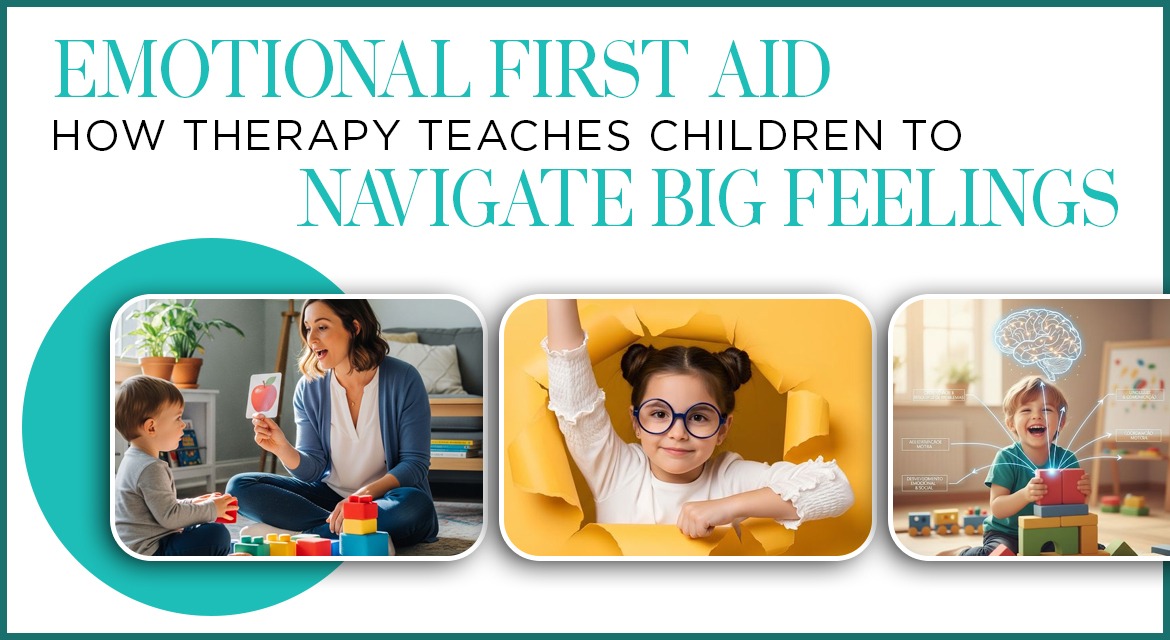
Emotional First Aid: How Therapy Teaches Children to Navigate Big Feelings
When a child scrapes their knee or bumps their head, we know exactly what to do. We reach for the “First Aid” kit, cleaning the wound, applying a bandage, and offering a comforting hug. We treat these physical injuries with urgency and care because we know that unattended wounds can become infected.
However, when a child experiences a “scraped” heart or an “injured” ego moments of intense rejection, overwhelming anxiety, or crushing sadness, the path to healing is often less clear. These are what we call Big Feelings. Without the right tools, these emotional wounds can fester, manifesting as behavioural outbursts, withdrawal, or chronic anxiety. This is where the concept of Emotional First Aid becomes essential.
At Horizon Healing Psychotherapy, we view child therapy not just as a way to “fix” a problem, but as a way to provide children with a mental health first aid kit they can carry for the rest of their lives.
Understanding the “Big Feeling” Brain
To help a child navigate intense emotions, we must first understand what is happening inside their developing brain. When a child experiences a Big Feeling, such as a surge of anger because they lost a game, their amygdala (the brain’s emotional alarm system) takes over. This triggers a “fight, flight, or freeze” response.
Because the prefrontal cortex, the part of the brain responsible for logic and impulse control is still under construction, children literally cannot “think” their way out of an emotional storm. They are hijacked by their biology. Therapy provides a bridge between these two parts of the brain, teaching children how to soothe the alarm system so the logical brain can come back online.
The Pillars of Emotional First Aid in Therapy
In a therapeutic setting, we teach children specific, actionable skills to manage their internal world. Here are the core pillars of Emotional First Aid that we focus on:
- Identification: Scanning for the “Injury.”
Just as you must find where a cut is located to treat it, a child must learn to locate their feelings. We help children move beyond “I’m bad” or “I’m mad” to identifying the physical sensations of emotion.
- Does your tummy feel tight?
- Are your hands clenched like a fist?
- Is there a “heavy” feeling in your chest?
By identifying the physical injury, the emotion becomes less of a vague monster and more of a manageable signal.
- Validation: The “Antiseptic” of the Soul
Validation is the most powerful tool in the emotional first aid kit. In therapy, children learn that all feelings are valid, even if all behaviors are not. When a therapist or a parent says, “It makes sense that you feel frustrated that the game ended,” it acts as an antiseptic. It stops the “infection” of shame. When a child feels understood, their nervous system begins to de-escalate automatically.
- De-escalation: Stopping the “Bleeding.”
When a child is in the middle of an emotional outburst, they need immediate tools to stop the emotional bleeding. In therapy, we practice “bottom-up” regulation strategies, such as:
- Box Breathing: Visualizing a square while inhaling, holding, exhaling, and holding.
- The 5-4-3-2-1 Technique: Finding five things they can see, four they can touch, three they can hear, two they can smell, and one they can taste to ground them in the present moment.
- Heavy Work: Using physical resistance, like pushing against a wall, to help reset the nervous system.
- Cognitive Reframing: Applying the “Bandage.”
Once the child is calm, therapy helps them look at the situation differently. This isn’t about “positive thinking”; it’s about accurate thinking. If a child thinks, “Nobody likes me because I wasn’t invited to the party,” we help them apply a cognitive bandage: “I’m sad I wasn’t invited, but I have three good friends with whom I played yesterday.”
How Therapy Empowers the Family
Emotional First Aid is not a skill learned in isolation. At Horizon Healing Psychotherapy, we believe the family is the primary healing environment. Therapy for children often involves coaching parents on how to be the “First Aid Responders” at home.
- The “Wait and See” vs. Proactive Approach: Many parents wonder if their child will simply grow out of their big feelings. While emotional maturity does come with age, the skills to manage stress do not happen by accident. By engaging in therapy early, families prevent the scrapes of childhood from becoming the scars of adulthood.
- Building Resilience: Resilience isn’t the absence of stress; it’s the ability to navigate it. When a child learns Emotional First Aid, they stop fearing their emotions. They realize that while a Big Feeling might be uncomfortable, it is temporary and survivable.
When Should You Seek “Professional” First Aid?
While parents are the first line of defence, some emotional wounds require a specialist. You might consider therapy for your child if:
- Their Big Feelings are interfering with school or friendships.
- The frequency and intensity of outbursts are increasing rather than decreasing.
- The child seems “stuck” in an emotion, such as constant worry or persistent sadness.
- Your usual parenting tools, time-outs, rewards, or talking no longer seem to work.
Conclusion: A Toolkit for Life
The goal of Emotional First Aid is not to create a child who never feels sad, angry, or scared. That would be impossible. Our goal is to create a child who knows what to do when those feelings arrive.
At Horizon Healing Psychotherapy, we are dedicated to helping your child build their unique toolkit. By teaching them to identify, validate, and regulate their emotions today, we are ensuring they have the mental health foundations to lead a fulfilling, resilient life tomorrow.
No wound is too small to care for, and no feeling is too big to handle with the right support.
Sadaf Khan is a Licensed Psychotherapist and the Founder of Horizon Healing Psychotherapy. She specializes in helping families navigate the complexities of childhood emotions through a compassionate, evidence-based lens.
Are you ready to help your child build their emotional first aid kit? Contact Horizon Healing Psychotherapy today to begin the journey toward a calmer, more resilient home.
- Psychotherapy sessions are virtual( meet from the comfort of your home)
- Timings: 10 am-3:30 pm. Evenings are available from 6pm to 10pm with a time/day consultation.
- some weekends available on request.


Useful Links
NewsLetter
Feel Free to reach out if you want to collaborate with us, or simply have a chat.

